


Thrinacia
The following landscape and accompanying game design was an assignment for my university's Game Design course. It was published on the class's blog, located here.
Please note that as an assignment, the project was designed to fulfill certain requirements related to material and content. In particular, I was challenged to design and develop a landscape based on an event from Books 9-12 of the Odyssey using Unity's terrain tools. This was followed by a short written outline of a game design that could utilize the landscape. Explanations of how the landscape matched Homer's descriptions were also required.
I chose to compose a landscape modeled after the Odyssey‘s Thrinacia, the final episode before the demise of Odysseus’s crew. Having overcome the previous challenges presented by the exotic Sirens and the deadly combination of Charybdis and Scylla, the Ithaca-bound heroes convince Odysseus to land on the shores of Thrinacia, home to the herds and flocks of Helios the sun god. Odysseus is reluctant to do so, given that both the spirit of Tiresias and the witch Circe had warned him of its dangers: Should he or his crew slaughter any of Helios’s beloved cattle or sheep, Odysseus would be doomed to return home alone after many years of hardship, his crew all but dead.
Unfortunately, soon after arriving on Thrinacia the island is beset by unfavorable winds that prevent the crew from leaving. Initially, the crew is able to survive on rations previously provided by Circe, but the relentless South Wind ensured they remained trapped on the island for a full month. Odysseus makes his way across the island to find a distant place to pray in an effort to gain assistance from the gods, but instead his prayers are met with a sudden fall into deep sleep.
Thrinacia, Land of Helios, Hyperion the Sun
Realizing Homer's Landscape
Overall, I think the landscape is effective in conveying the theme and action during Odysseus’s stay in Thrinacia. The story here wasn’t a single, short, linear event, but a prolonged struggle that suggests a number of open-ended hardships. Thrinacia will take a decent amount of time to fully explore, and in that time players will have several options in how to proceed. Just as in the Odyssey, the danger will not seem readily apparent until long after the game has started and the player begins to realize there is greater risk surviving this slow-paced island than there ever was in the faces of previous threats like Scylla or Polyphemus. The seemingly innocent cattle and sheep will serve as a constant reminder of death, that doom is but a broiled steak away as rations begin to dwindle. Over time the beautiful landscapes and animals of Thrinacia will slowly transform into a hellish prison that foreshadows the player’s inevitable fate.
A Game of Survival
My vision for Thrinacia is that of a real-time strategy (or RTS) game. It would derive gameplay elements from such titles as StarCraft and Pikmin. The goal of the game would simply be to survive as long as possible by exploring Thrinacia and leveraging its resources without giving in to temptation. Ultimately it would be impossible to maintain positive resources and players will be forced to lose one way or another. On one level this gives first-time players an intimate understanding of the events that occurred in Thrinacia, and on another level it gives experienced players the challenge of “getting a high score” by surviving a record number of days.
“Survival” is determined by the crew’s current level of food. Over time the crew will slowly consume food, represented by an integer value. To increase this value and prolong survival, Odysseus and his crew must complete certain objectives to find food. These objectives include:
– Hunting birds
– Fishing
– Completing tasks for Lampetia and Phaethousa
– Exploring the local caves
If the level of food reaches zero, Odysseus and his crew will starve to death. However, in keeping with the story, the far more likely event is a loss by temptation.
Every member of Odysseus’s crew is controllable and can be set to perform tasks. However, each member also has a “temptation” threshold. As food depletes, passing by cattle or sheep will “tempt” crew members, and if unsupervised they may slaughter the animals for food. This can be prevented by having Odysseus or other “untempted” crew members in the vicinity. Each member of the crew will have his own individual strengths and weaknesses (such as “Good at fishing”, “Poor at combat”), a unique name (for example, only one unit will be named “Eurylochus”), and a “temptation level”. Crew members will begin to be tempted when food levels are below their temptation level, becoming more strongly tempted the further food levels are below their temptation levels. The amount of influence “strong-willed” crew members have at stopping “tempted” members also depends on food levels. Generally, the player just needs to know that “the lower the food level, the more difficult it is for me to manage my crew and accomplish tasks”. As temptations begin to increase, it’s important for players to ensure tempted units don’t cross paths with cattle or sheep, or that they are supervised when they do so. Only Odysseus is immune to temptation (a gameplay mechanic that is synergetic with the overall story theme).
Generally, gameplay will consist of trying to optimize resource management. The player can choose to set X number of units to fishing to increase food stores to buy extra time, but that means there will be X less players working on other tasks that could potentially lead to even more food opportunities, such as building a bridge to a new area. Weighing these options and optimizing food gain is the crux of gameplay.
The list of tasks units can perform includes:
– Hunting birds
– Fishing
– Breaking rocks
– Cutting trees
– Building structures (denoted by log “start points”)
– Escorting sheep or cattle
– Fighting enemies
– Carrying loot back to the ship
To perform these actions, players will manage the game from a top-down perspective overlooking the environment. Players can select units and direct them by putting them to the various tasks across the map.


Meanwhile, Eurylochus convinces the rest of the crew that their only chance for survival is to slaughter the sun god’s oxen for food, arguing that it would be better to risk drowning from divine punishment than to starve to death. They begin killing and consuming the sacred cows while Odysseus is away, much to his dismay upon his return. For six more days, the cattle of Helios were consumed by Odysseus’s crew until the winds that had besieged the island finally ceased. Odysseus and his crew make their escape, but Zeus exacts revenge on behalf of Helios and shatters their ship. The crew is decimated and Odysseus is swept away to the island of Calypso, fulfilling the previous prophecies.


My philosophy as a game designer is that a virtual landscape is meaningless outside the context of a game and its array of mechanics. For example, a short fence has an entirely different contextual meaning depending on if the player has the ability to jump. Similarly, there is no value in having a series of resource nodes embedded into the terrain without having a game system in place to acquire and leverage those resources. As such, I envisioned a game system to take advantage of my landscape before I sculpted a single hill, and that design was at the heart of every decision I made regarding my imagining of Thrinacia. However, I’ll first describe my attempt at bringing Homer’s words to life before elaborating on the game system.
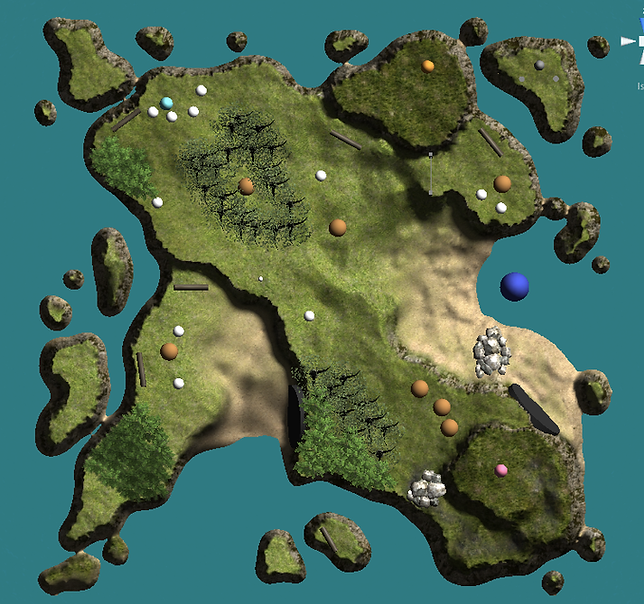
Beginning with the basic shape, I first tried to research the mythology behind Thrinacia. As it turns out, the name Thrinacia is thought to be partly derived from the Greek language for the number three. This has led some scholars to believe Thrinacia may have been based on Sicily, which has a sort of three-point shape. I took inspiration from this discovery and constructed the island with three largely prominent “points”: The initial beach point Odysseus arrives at in the southwest, the outcropping Lampetia and the majority of her flock of sheep reside at in the northwest, and the hill in the southeast from which Phaethousa watches over her cattle. Discounting the miniature shrine rock I added off the northeast side of the island, my Thrinacia looks fairly similar to an upside-down Sicily.
As one might have already inferred from the above paragraph, I also integrated the nymph daughters of Helios into the map: Phaethousa and Lampetia. While not prominent in the Odyssey story itself, I thought it would be interesting from both narrative and gameplay points of view to explore what impacts the nymphs may have had on Odysseus and his crew during their stay. As per Greek lore Phaethousa took charge of Helios’s cattle while Lampetia managed his flocks of sheep, so I’ve made sure to identify each shepherdess with her respective animal both in the environment and in the gameplay.

Speaking of animals, considering how integral Helios’s cattle and sheep are in this particular story, I’ve spread them across the map. So that I would not waste time modeling their figures, I represented cattle with large, brown spheres and sheep with smaller, white spheres. They serve as a constant reminder of the island’s dangers and temptations, an idea that is also integrated into the gameplay itself.
While not explicitly depicted in the landscape, Thrinacia would also feature other indigenous game, specifically birds and fish. When rations ran low, Homer described Odysseus and his crew as preying on birds and fish for food. Having incorporated this idea into the gameplay, players can hunt for birds across the island and can fish from either of the two beaches.
Key to the story are the members of Odysseus’s crew, Eurylochus in particular. Like Phaethousa and Lampetia, I thought it would be a great opportunity to involve characters like Eurylochus in the design. I have not represented Odysseus’s crew on the map simply because they are not tied to any one location, but rest assured that they would have a roaming presence.
In terms of specific locations from the Odyssey itself, the first is the initial landing site for Odysseus’s crew. There is a beach in the southwest that the player starts from. Being on the south side, the location aligns with the poem’s explanation for Odysseus’s predicament: Thrinacia was beset by the South Wind, preventing the heroes from escaping.
According to Homer, there was a nearby cave that Odysseus and his crew hauled the ship into. For my landscape, I elected to represent this cave with a black cylinder. In a final game, I would imagine that the interior of the cave could be designed as a separate, instanced terrain that could be “entered” via a set piece designed to resemble the opening of a cave.
Another explicit feature that Homer describes is a distant location that Odysseus arrives at to pray before becoming plagued with sleep. I elaborated on this idea a bit, representing it as a sort of “shrine” hidden away on an island outcropping far on the opposite side of the map from the arrival point. Ultimately, gameplay progression would coalesce at this spot, inevitably resulting in Odysseus’s slumber and the damning of the entire crew.

At this point I began to take liberties with certain locations and entities. Knowing that at least one cave exists on the island, I’ve placed a second cave in the southeast that would lead to another instanced environment with its own goals and rewards. There are also two enemy characters: The Cyclops and the Sea Witch. I had read that, just as with Thrinacia, some believe that the home of the Cyclopes described in the Odyssey might be related to Sicily. I thought it would be fun to acknowledge this small connection between the two lands by having a Cyclops lord over the northern portion of the island. Similarly, I wanted to provide an obstacle to the second beach and the entrance to the second cave, so I included a Sea Witch enemy, presumably a minion of Poseidon sent to find and eliminate Odysseus’s crew.


Survival: With limited resources, Odysseus and his crew must survive as long as possible. Survival implies a sort of management of resources, both in terms of supplies (such as food or lumber) and manpower (Odysseus and his crew). Learning to stretch resources as far as they will go and feeling the struggle of inevitable loss will help players empathize with Odysseus and feel the looming danger.
Exploration: A sort of extension of the idea of Survival combined with the implications in Homer’s text that the crew explored the island to prolong their fate. Exploration elements often go hand-in-hand with Survival, and this story is a good example. As resources are consumed, players will be forced to expand their reach and search for new locations and opportunities.
Temptation: All of the resource problems presented by the theme of Survival can easily be “solved” by slaying any of the incredibly common cattle or sheep. Players will quickly find that giving in to this Temptation is essentially the same as giving up, a “Lose” option in disguise. However, Temptation will become a driving gameplay mechanic in the latter half of the game regardless of the player’s intentions and will play against the Survival and Exploration mechanics.
In designing a game to build my map around, I focused on the major gameplay themes I saw in Thrinacia. I arrived at the ideas of Survival, Exploration, and Temptation.

There are several areas that present more “interesting” challenges. The southeast cave would ideally lead to a whole new sub-area with all sorts of treasures and resources waiting to be plundered. Beyond that, both Phaethousa and Lampetia are present on the island and can communicate with Odysseus. They will understand his plight and will offer food and other resources in exchange for his aid in completing tasks. Such tasks could be as simple as rounding up scattered cattle or sheep (acting as yet another temptation) or as elaborate as dealing with the local Cyclops. Completing all of the nymphs’ requests will result in a gate to a local shrine being opened. By this point in the game, players will have accomplished all major challenges and sending Odysseus to the shrine will have him perform his fateful prayer. At this time the crew will inevitably become consumed by temptation as food levels drop and the game will end.
As a landscape, Thrinacia is particularly well-suited to gameplay and elegantly integrates the key themes of Survival, Exploration, and Temptation. Not only does it provide genuinely interesting gameplay opportunities, it communicates a story within the Odyssey that resonates at a personal level and serves to deepen the player’s appreciation for Homer’s epic.
My initial rough sketch of Thrinacia
An inverted Sicily
The final landscape of Thrinacia, as seen from above in the Unity editor
Phaethousa and the Sea Witch
The flow of progression through Thrinacia. Players start with yellow and progress to orange, then purple, and finally blue. Red dots denote locations for secrets, resources, and objectives.
*Note that the labels for Phaethousa and Lampetia should be reversed.
A gameplay camera angle of the initial area. It’s flow is designed to teach the player the basic mechanics of food, temptation, and construction before leaving for the main part of the island.