


Review: Super Metroid
The following is a review of Super Metroid that I wrote for my university's Game Design course. It was published on the class's blog, located here.
Please note that as an assignment, the review was written to fulfill certain requirements related to content and length.
The Last Metroid is in Captivity

Yoshio Sakamoto’s Super Metroid stands as one of the most significant titles of the gaming medium. It follows heroine Samus Aran, space bounty hunter extraordinaire, as she returns to the planet Zebes in an effort to recover an infant Metroid (a type of alien parasite) from the dreaded Space Pirates.
Super Metroid‘s clever design and distinct atmosphere remain relevant today despite technological advancements, arguably providing a richer and deeper gameplay experience than many contemporary works. Super Metroid captures this essential experience through three core themes: Isolation, Empowerment, and Exploration.
No One Can Hear You Scream
The Metroid franchise is known for its intense sense of isolation. Players are plunged into a foreign environment with absolutely no explicit direction and lacking the proper tools needed to fully explore and conquer their surroundings. In Super Metroid, this suffocating loneliness is further exacerbated by the utter lack of any dialogue or NPC communication whatsoever.

The atmosphere is achieved primarily through the stunning art direction, melancholic score, and effective sound design. Sakamoto’s team realized a truly alien world, a planet infested with labyrinthine caverns and secret passageways divided into distinct regions. Bizarre and unexpected surroundings will surprise players at every turn, whether it’s the abundance of fauna in the depths of Brinstar, statue remnants of the bird-like Chozo race, or an ethereal presence hidden within the crashed ship atop Crateria. The alien inhabitants themselves range from strange ostrich-like bipeds to burning sea horses to one particularly nasty archnemesis of draconic proportions.
Pink flora hangs in the air in Brinstar.
Each region is characterized by cohesive visual themes. The volcanic Norfair is appropriately oppressive and foreboding, rife with deep reds and pulsing effects that suggest intense temperatures. (In fact, Samus will take damage from the heat prior to acquiring the Varia Suit.) Maridia, on the other hand, communicates a sort of uneasy serenity in its clear waters and subdued colors.
In a similar manner, the sound direction of Super Metroid is a key ingredient in establishing its atmosphere. Like the visuals, the cries and shrieks of the alien organisms are fittingly unfamiliar. Even more striking is the memorable soundtrack – every player remembers their first time entering the red soil region of Brinstar and hearing that echoing crescendo, or the overbearing beat of Norfair’s lower depths en route to a particularly climactic encounter.

The penetrating flames of Norfair.
In a similar manner, the sound direction of Super Metroid is a key ingredient in establishing its atmosphere. Like the visuals, the cries and shrieks of the alien organisms are fittingly unfamiliar. Even more striking is the memorable soundtrack – every player remembers their first time entering the red soil region of Brinstar and hearing that echoing crescendo, or the overbearing beat of Norfair’s lower depths en route to a particularly climactic encounter.
What these aesthetic elements should impress upon the reader is that Super Metroid goes to great lengths to bury the player in a strange, foreign environment. In addition, the lack of communication or dialogue of any kind and the player’s relative weakness at the beginning of the game paired with a lack of explicit guidance or direction generates an almost palpable sense of isolation. As a result, players become more immersed in the world and more strongly identify with the player avatar, ultimately leading to a greater sense of growth through empowerment.
One of the core components to the Metroid franchise’s design is empowerment through the acquisition of a great number of abilities and items. Initially, Samus starts the game with almost no items. Players feel weak and vulnerable, an emotion emphasized by the player’s initial encounter with the alien antagonist Ridley near the start of the game. He cannot be defeated, and the player’s struggle and narrow escape brings them to the realization that their current abilities are woefully inadequate for the adventure ahead.
Screw and Balls

A hopeless encounter.
Over the course of gameplay, the player will acquire new abilities and weapons that will open new opportunities for them around the game map. One moment the player might discover a Gravity Suit that will allow Samus to gracefully navigate aquatic environments without impediment, and at another become equipped with Power Bombs strong enough to eradicate even the toughest of enemies. By the end of the game, players will even become capable of flight and nigh-invulnerability through the combination of the Space Jump and Screw Attack items. This leads to an inevitable rematch with Ridley, his defeat bringing the player not only personal satisfaction but a sense of “completeness” having just been able to conquer that which was unconquerable at the start of the game. (This theme of empowerment is revisited again at the climax of the game when the baby Metroid grants Samus the power of the Hyper Beam to vanquish the final boss, Mother Brain.) This mastery and understanding of player psychology is truly remarkable.

Reaching new locations with the Morph Ball.
However, I would argue that an even greater achievement of Sakamoto’s approach to player empowerment is not in the themes and player emotions, but in the core gameplay mechanics. The items the player gathers have genuinely clever and interesting gameplay implications beyond simply providing player fulfillment and unlocking arbitrary locks. Each ability encapsulates a core idea that is fully explored and revisited by the level design, forcing players to rethink their approach to old and new environments alike. The Morph Ball allows Samus to squeeze through the tightest crevices, the Ice Beam turns enemies into potential stepping stones, and the Speed Booster gives Samus the ability to break through old barriers and blast across empty spaces. Items create a context for the game world, resulting in a game that remains static throughout in layout, but dynamic in its layers, shifting flows, and player exploration.
From Crateria to Tourian
The final component of Super Metroid‘s essential gameplay experience is exploration. Isolated and searching for a means of empowerment, players will explore the world of Zebes to plunder its secrets and rewards. This is perhaps the most important element of the player’s experience as it acts as a vehicle to further emphasize the first two elements.
The design and structure behind Zebes is pure genius. There are an incredible number of subtle details and intricacies that are rarely discovered by players on their first plays. It is a beautifully woven fabric of secrets, puzzles, and gameplay mechanics that seems to magically shift with each subsequent run. In fact, one of the core design elements behind Zebes is the idea of sequence breaking, the ability for clever players to tackle the game in an unorthodox order. For example, right before Kraid’s Lair is a tall platform that most players will not be able to scale, prompting them to delve into Norfair to recover the High Jump Boots to give them that extra jumping height. However, players that have mastered the special wall jumping technique will be able to enter the lair without the special item. There are countless instances of this type of gameplay, demonstrating the true skill and insight that went behind the architecture of the game’s design.

Developers Map
This structure has given rise to entirely new ways to approach the game, from speed runs (beating the game in the shortest amount of time possible) to low percent runs (beating the game with the fewest items possible). They are incredibly entertaining to watch, and moreso to attempt oneself. It gives the player a deeper appreciation for the game’s layered design so that it seems to get only more enjoyable and enriching with subsequent play throughs.
Another aspect of Super Metroid‘s explorative element is its smartly designed “guiding” segments. As previously mentioned, a core element of the game’s isolating atmosphere is the lack of dialogue or explicit instructions, but that is not to say that players will become lost or clueless. While Super Metroid‘s design truly is non-linear, this is only an illusion to the novice player. There are a plethora of “guardrails” to keep players on the right track, such as the aforementioned impasse to Kraid’s Lair. There are many doors and paths throughout the game, but most routes are blocked without the appropriate items. For example, the only real available path for beginning players is to discover the Morph Ball, which will subsequently enable them to acquire the Missiles and Bombs and open the paths into deeper Brinstar.
In a similar manner, while most players are not explicitly taught how to effectively use certain items, they are often thrust into safe, controlled situations where the only means of escape is an understanding and use of the newly acquired ability. This can be seen when the player first discovers the Morph Ball, seeing as the only exit is a tight corridor that requires the player to be in ball form.
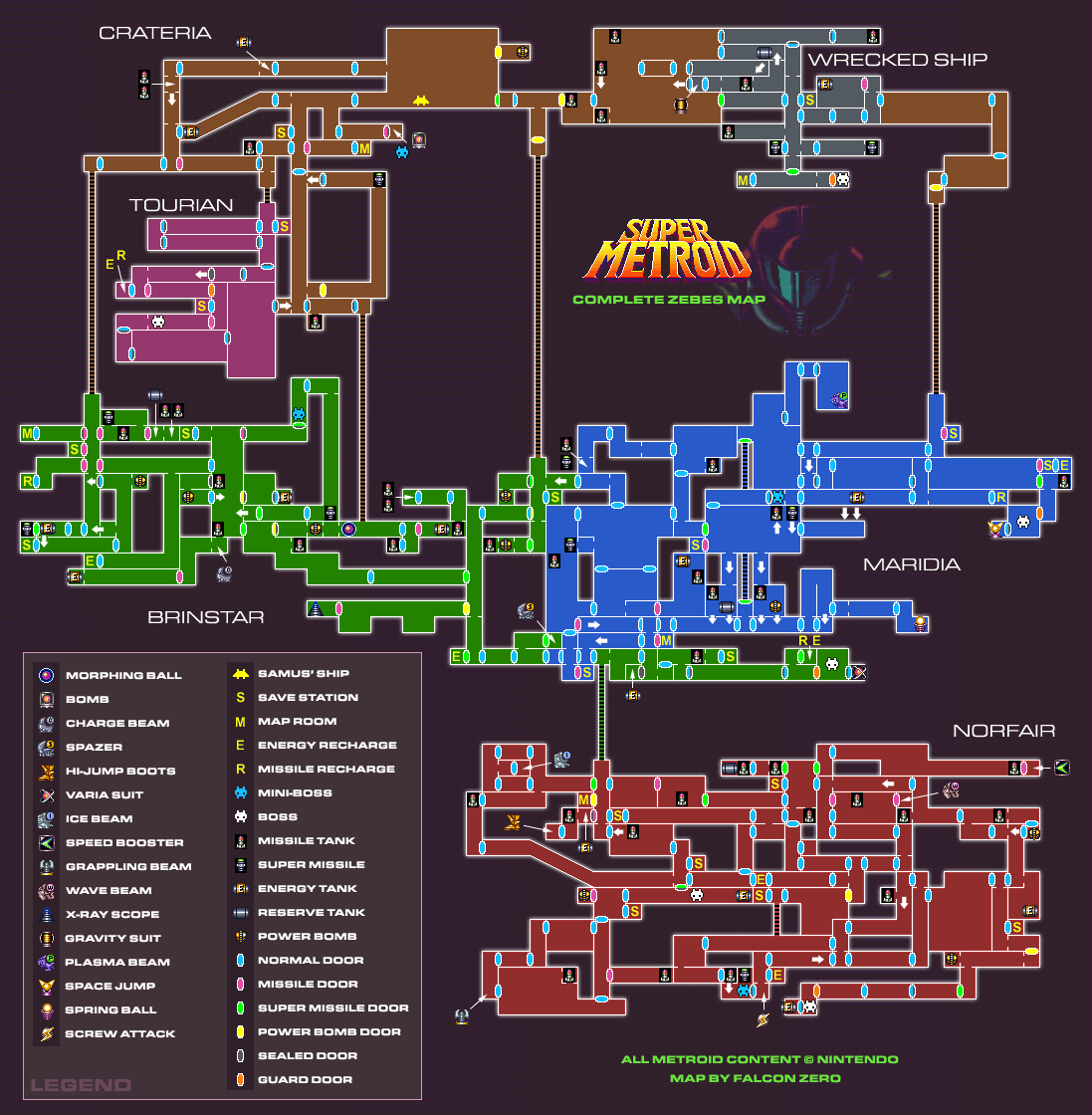
Game Map
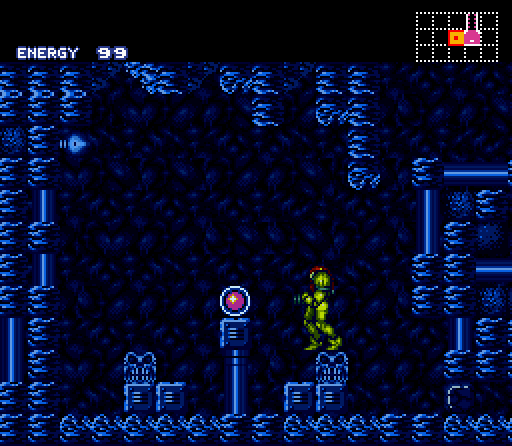
The only reachable exit is in the lower right...
Another pair of examples are the wall jump and shinespark techniques, abilities that are innate to Samus but are never documented or explained to the player prior to the player encountering the Etecoons and the Dachora. Through imitation, the player learns from these curious creatures how to utilize these special techniques to escape their respective situations and leverage them in later parts of the game. Ultimately, I would argue that this means of teaching the player the rules and the mechanics of the game is generally superior to simple textual instruction. Besides giving the player a greater sense of satisfaction and treating them like an intelligent being, it is an incredibly elegant and nonintrusive means of communicating information while maintaining the game’s atmosphere.
The Galaxy is at Peace
Through its ideas of isolation, empowerment, and exploration, Super Metroid has earned its place as one of the most significant works within its medium. Its elements of non-linearity, layered design, immersive atmosphere, dynamic abilities, synergetic themes and gameplay, and minimalistic story and dialogue are remarkable even by today’s standards, and many modern designers would do well to study, understand, and apply what it has to teach and offer us about game design. In an industry atmosphere that encourages shallow, easily consumed designs in both “core” and “casual” products alike, it’s rare to see an effort like that of Sakamoto’s team.
To be fair, perhaps the population at large simply doesn’t care for the sorts of ideas present in a game like Super Metroid. Many players seem to like linear structures, preferring guidance and explicit achievements and recognition. Isolating atmospheres like Super Metroid‘s can at times be too stifling or overbearing for some. A lot of consumers play games to feel empowered, but not necessarily for the process of becoming powerful; being weak and vulnerable is an unenjoyable experience for them. Regardless of these opinions, I don’t think they should reflect on the quality of Super Metroid as a work, in the same manner that mainstream sales and preferences in mediums such as film and music aren’t inherently indicative of worth.
I cherish games as a medium for artistic expression, and I see Super Metroid as a beautiful representation of that idea. It has greatly impacted my views and design sense, and I hope it will do the same to the readers of this review. In the meantime, perhaps I should dust off my Super Nintendo one more time…

A sign we are nearing the end...