


Review: Pikmin
The following is a review of Pikmin that I wrote for my university's Game Design course. It was published on the class's blog, located here.
Please note that as an assignment, the review was written to fulfill certain requirements related to content and length, moreso than in my other written assignments. In particular, I was required to make comparisons to the Odyssey, describing its game-like nature. While the review may feel somewhat artificial in its structure, rest assured that my love for Pikmin is anything but.
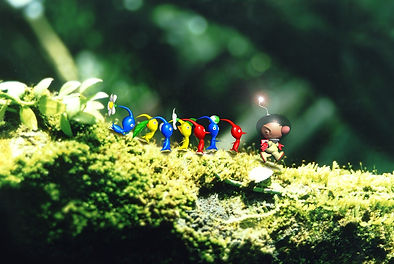
A Stranded Dolphin
In recent years I have come to regard Shigeru Miyamoto’s Pikmin as one of its generations most interesting works. It stars the intrepid space explorer Captain Olimar, an alien that crash lands on a “foreign” planet. Olimar quickly befriends the native Pikmin, a race of sentient ant-like plants that can be controlled and directed in large, swarming numbers. However, with only an emergency air supply protecting him from the poisonous oxygen atmosphere, Olimar has but thirty in-game days to repair his ship and return home.
While a significant title in its own right, Pikmin has much in common with Homer’s Odyssey. Both works center their narratives around the idea of nostos, a journey home fraught with difficulties and losses. Like Odysseus, Olimar must demonstrate cunning and intellect to repair his ship and return to his family. While Pikmin, in traditional Miyamoto fashion, emphasizes its ideas through gameplay rather than explicit narrative, I think a number of comparisons can be made through analogous concepts relative to each work’s respective medium.

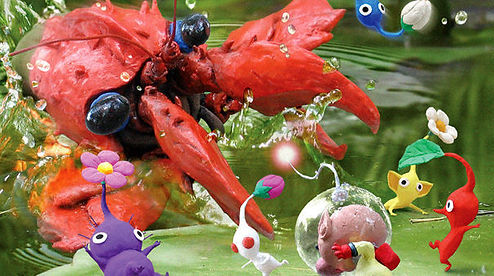
Note that while this is a review of the original Pikmin, I have found it both appropriate and irresistible to post artwork from the franchise as a whole.
The Heart of a Game
The core gameplay of Pikmin integrates ideas of curiosity and surprise at a deep level. Beginning with Olimar’s first steps at the Impact Site, players are motivated to explore their environment by a sense of curiosity: ”Where am I?” ”How will I get home?” ”What is this glowing sprout that begs to be plucked?” ”What are these Pikmin, what are their abilities, and how can I leverage their individual talents to overcome the obstacles presented to me?” Even in repeated playthroughs, the game’s thirty day structure prompts players to question how they can optimize their actions by minimizing the number of days it takes to complete the game. Other questions might also include, “How can I reduce the number of Pikmin casualties?” or “How quickly and efficiently can I build my legions of Pikmin?”

The Odyssey is similar in this regard not only from an interactive reader’s point of view (“Will Odysseus return home?” ”How will he do so?” ”What events transpired since the end of the Trojan War that led him to this point in the story?”) but from within the narrative itself, such as Odysseus’s crew questioning the contents of the bag of Aeolus, or each party questioning the thoughts and intentions of the others during Odysseus’s interactions with Nausicaa, Alcinous, and the other Phaeacians. Odysseus, with all his cunning, also parallels a player’s curiosity in figuring how to minimize his losses to Scylla just as Olimar does with his Pikmin.

An encounter with the deadly Snagret.
Both works also include a large number of surprising events and occurrences. Olimar’s adventure regularly includes visiting and interacting with foreign entities that prove to be both surprising and fantastic in their abilities. Most players will recall their first encounters with the serpentine Snagrets, their plucking of Pikmin paralleling that of Scylla or Polyphemus consuming Odysseus’s own crew. Intruding upon the grounds of the seemingly innocent Puffstool results in the twisted transformation of Olimar’s innocent allies. Such a surprising turn of events bears similarity to the corruption wrought on Odysseus’s men from Circe’s magic or the consumption of the lotuses. In both works, the protagonists (and the player/reader) are constantly encountering new and surprising challenges that are overcome through cunning, intellect, and effective utilization of available tools and resources.
In fact, it is these exact elements that contribute to a sense of fun. Pikmin has a base set of mechanics that I believe are intrinsically interesting – management, multitasking, and decision-making lie at the core of the gameplay. Extending from this are the three types of Pikmin, each supplying unique abilities that range from fire resistance to water-breathing. These mechanics, wrapped up in the context of a non-linear, thirty day structure, create a truly novel and entertaining work.
The Odyssey similarly achieves a level of fun through its game-like components. Players engage in reading the Odyssey willfully with the goal of understanding the narrative and seeing Odysseus through on his nostos. By reading the material in a critical and observant manner, players are interacting with the narrative and its inherent challenges, both in comprehension and a deeper understanding of the layers present in its characters, scenarios, and meanings. This creates the gameplay “conflict”, bound by the “rules” of the Odyssey‘s narrative, the limits of what is said and done. This deeper appreciation for the intricacies and subtleties of Homer’s work gives players endogenous value, and acquiring this sense of understanding and fulfillment grants players “victory”. All of this is presented within the context of a closed, formal system in the form of an epic, structured poem with definite writings and information. The Odyssey evades the rails of linear storytelling not only in the traditional sense (the events prior to Odysseus’s extended stay with Calypso aren’t even made known until his retelling to the Phaeacians) but in the way it challenges readers to consistently reevaluate and analyze what is said, what is done, and what it all means in both a literal and metaphorical sense. These mental challenges culminate in a level of engagement that is inherently fun and enjoyable.
The Art of Conveyance
One of the most important aspects of a game is its gameplay structure and mechanics. These elements will best manifest themselves through a game’s problem-solving challenges. In order to effectively facilitate these challenges, a great game must have good conveyance, the ability to communicate mechanics and ideas in an intuitive, elegant, and non-intrusive manner.
Pikmin routinely demonstrates exceptional use of conveyance. While initially presenting the player with a short series of basic control explanations (“Press ‘A’ to pluck and throw Pikmin”, “Press ‘B’ to call Pikmin to your side”, etc.), the majority of the game elements are left to the player to discover. For example, beginning from the very first area, it is always emphasized that “throwing Pikmin” is the main action you associate with interacting with in-game objects. Does that flower with the number on it look suspicious? Throw a Pikmin at it. Need to push a box? Throw a Pikmin at it. Need to defeat an enemy? Throw a Pikmin at it. All of these mechanics are further emphasized by the GameCube’s progressive controller; the large, obvious ‘A’ button is almost always associated with the “primary action”.
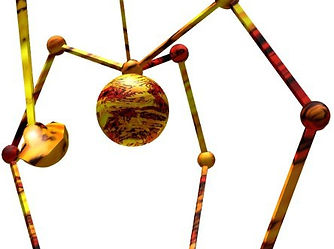
The curious Beady Long Legs
Most game mechanics are intuitively understood in Pikmin through effective conveyance largely due to color association. The three Pikmin types all have abilities associated with their colors: Red Pikmin are resistant to fire, blue Pikmin can walk through water, and yellow Pikmin can manipulate yellow bomb rocks. Flower pellets, which can be brought back to base to produce more Pikmin, come in three color varieties (red, blue, and yellow); most players will quickly understand that pairing pellets with their respective colored Pikmin will result in bonus sprouts. In the Beady Long Legs boss encounter, the spider’s vulnerable body is suspended high above the ground by its long legs. However, yellow Pikmin (which reach a greater height when thrown) can still reach and latch onto it. This is hinted at by the creature’s primarily yellow color scheme. These clever problems and challenges require a thoughtful approach to solve, one that is made more elegant by the game’s conveyance.
The Odyssey applies these ideas in a similar manner. Readers are not beat over the head with blatant explanations and statements and are instead given subtle clues and insights into the motivations and personalities of various characters, and it is up to the reader to “solve” and understand the narrative. An excellent “battle” of wit, information, and social interaction begins with Odysseus’s first meeting with Nausicaa and extends throughout his stay on Phaeacia; each figure is working to glean knowledge from the others in an attempt to gain an upper hand. Readers can also gain an insight into each character’s personality and development through the story by their actions. For example, Odysseus could not resist revealing his name to Polyphemus at the beginning of his nostos, but by the time he reaches Phaeacia he has learned that keeping his identity a mystery can provide certain advantages if one is not consumed by pride. Foreshadowing and allusions, such as Demodocus’s story about Hephaestus, Aphrodite, and Ares, give the reader a clue as to what is coming when Odysseus returns to his own home and finds it overtaken by suitors.

The mark of a good game is how well it balances the four elements of mechanics, aesthetics, story, and technology, and Pikmin encompasses all of them. The mechanics that inspired Pikmin, which were not viable on older platforms, came about directly due to the develop of technology on the GameCube. The GameCube, unlike the Nintendo 64, was capable of tracking hundreds of concurrent game objects, most widely seen in the Super Mario 128 demo that sported countless Mario characters running about a playing field. This idea of controlling and directing numerous units with varying abilities brought about Pikmin’s mechanics, described previously. From there, the aesthetics for Pikmin became inspired by Miyamoto’s hobby of gardening, providing an elegant means by which the developers could implement strange and colorful creatures to represent the abstract mechanics. Finally, a simple but engaging homecoming story gives a context for the player’s actions and abilities throughout the gameplay.
Balance of Elements

Super Mario 128
The Odyssey shares similar analogues to this elemental tetrad. It’s long history of existence was made possible by its use of some of the most basic technology: language and the spoken word. Its most prominent element, that of story, needs no mention. What’s more remarkable, however, is Homer’s integration of game-like mechanics as described previously, all elegantly interwoven within the fabric of the story. All of this is brought to life through the detailed environments and events within Greek mythology, the aesthetics of the epic. These four elements remain in balance and have contributed to the Odyssey‘s success as one of the cornerstones of Western literature.

Bringing It Home
Pikmin is so incredibly creative and so very well-designed. It took me years to appreciate its flowing, non-linear design once I could overlook the hard time limits and multitasking elements and learn to appreciate their beauty. However, finding these parallels with Homer’s Odyssey have given me reason to fall in love with it all over again. By that same token, I have come to enjoy Odysseus’s great journey home on a higher level of appreciation than ever before. I hope that I have effectively communicated that to the reader, and that this review will prompt the reader to explore these two brilliantly related works across their two mediums.